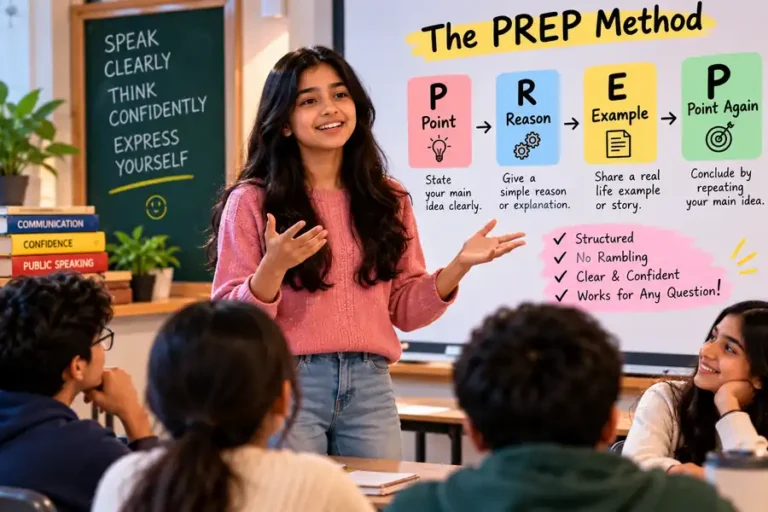
6 Everyday Habits That Build Speaking Confidence at Home
Confidence isn't built on stage. It's built at the dinner table, in the car and on voice notes. Six small habits that make a big difference over time.
We often imagine confident speakers as people who were “just born that way”. In reality, most confident speakers had one thing in common growing up: lots of chances to talk and be properly listened to.
That’s good news for parents, because you don’t need a stage, a microphone or a special class to start. Some of the best speaking practice happens at home, in five-minute moments that fit into a normal day.
Here are six simple habits worth trying.
1. The dinner-table question
Swap “How was school?” (answer: “Fine.”) for a question that needs a real answer.
- “What’s something you learned today that surprised you?”
- “If you could change one rule at school, what would it be and why?”
- “Who was the funniest person in your class today, and what did they do?”
Let everyone at the table answer, including adults. Children learn a lot from hearing how others structure a thought. And keep it light: this is a conversation, not an interview.
2. “Teach me something”
Once or twice a week, ask your child to teach you something from their day: a science idea, a maths trick, a history story. Play the curious student. Ask “Why?” and “What happens if…?”
Explaining something to someone else is one of the best ways to understand it deeply. It also builds the habit of organising thoughts out loud, which is exactly what speaking confidently requires.
3. Read aloud, with feeling
Reading aloud isn’t just for small children. For older kids, try reading a short news article, a poem or a page from a novel to the family. Encourage expression: slow down for the serious parts, speed up for the exciting ones, pause at full stops.
This builds voice control, clear pronunciation and comfort with being listened to. Bonus: it often sparks great conversations.
4. The one-minute opinion
Pick a fun, low-stakes topic and give each person one minute to share their view. Topics can be silly or serious:
- “Is it better to live in the mountains or by the sea?”
- “Should pets be allowed in school?”
- “What’s the best festival food, and why?”
A phone timer adds a little game-show excitement. Over time, children get used to forming an opinion quickly and saying it clearly, a skill they’ll use in class, debates and interviews.
5. Voice notes instead of texts
If your child messages family members, encourage voice notes to grandparents or relatives instead of typing. It’s speaking practice in disguise: they have to organise a thought, say it clearly and keep it brief. Grandparents usually love it, too.
6. Let them do the talking out in the world
Small real-world moments build big confidence:
- Ordering their own food at a restaurant.
- Asking a shopkeeper about a product.
- Calling a relative to wish them on their birthday.
- Asking for directions or help at a station.
Resist the urge to step in the moment they hesitate. A few seconds of silence is fine. Let them find their words, and afterwards, mention one thing they did well.
How to listen so they keep talking
Habits only work if children feel heard. A few listening tips make a big difference:
- Put the phone down when they’re speaking. Attention is the strongest encouragement.
- Don’t correct every mistake mid-sentence. Let them finish first. Fluency matters more than perfection at this stage.
- Ask a follow-up question. It shows you were really listening and encourages them to go deeper.
- Notice effort out loud. “That was a really clear explanation” goes a long way.
Small and steady wins
None of these habits will transform a child overnight, and they don’t need to. Confidence builds like fitness: a little practice, done regularly, adds up to a big change you’ll notice months from now, maybe when your child volunteers to give a speech, handles a question confidently, or simply tells you about their day in rich detail.
If you’d like to add structured practice to these home habits, our Speak Up course helps students speak clearly and feel confident, and like every Z-Alpha-Ed class, it ends with students actually doing it. You can see how it works in a free demo class.
Every Z-Alpha-Ed class ends with students doing something, not just listening.
Found this useful? 💬 Share on WhatsApp ← All articles