Why Your Child Knows the Answer but Won’t Raise Their Hand
Plenty of bright students go silent the moment they're asked to speak. It's rarely about knowledge. Here's what's really happening, and how to help.
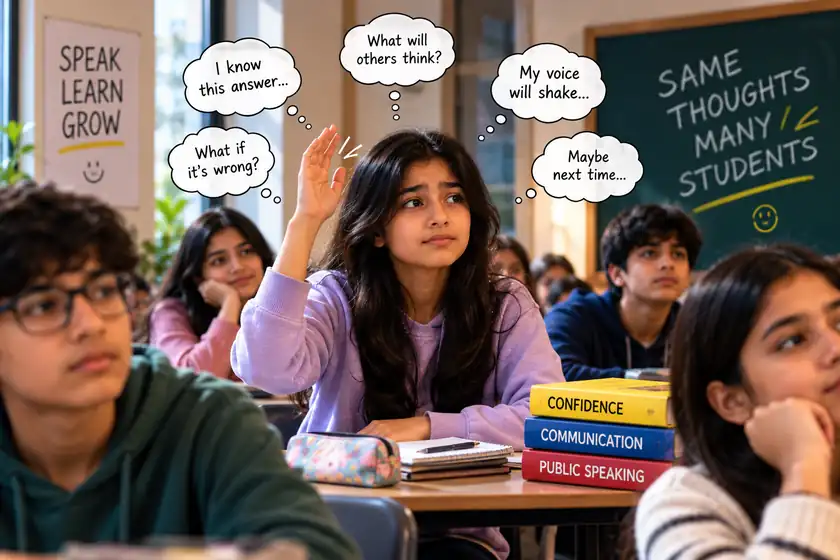
The teacher asks a question. Your child knows the answer. You know they know, because they explained it perfectly at the dinner table last night. But in class, their hand stays down. If they’re called on, the answer comes out as a mumble, or not at all.
If this sounds like your child, they’re in very good company. Feeling nervous about speaking in front of others is one of the most common fears people have, at every age. Plenty of confident, successful adults still get sweaty palms before a presentation.
The important thing to understand is this: a quiet child is rarely a child with nothing to say.
What’s actually going on
When a child freezes before speaking, a few things are usually happening at once.
The fear of getting it wrong in public. A mistake in a notebook is private. A mistake said out loud feels like the whole class saw it. For a child who cares about doing well, that risk can feel bigger than the reward.
The “everyone is looking at me” feeling. When attention suddenly turns to you, your body reacts as if something is at stake: faster heartbeat, dry mouth, a mind that goes blank. It’s a natural stress response, not a weakness.
Not knowing how to start. Many children have the answer but not the first sentence. Without a simple way to begin, they wait, the moment passes, and the silence becomes a habit.
Comparison. If one or two classmates always answer quickly and confidently, quieter children can start to believe that speaking up is “their thing”, not something anyone can learn.
Shy, introverted or just unpractised?
These are often mixed up, and they’re not the same.
- An introverted child may simply prefer to think before they speak and enjoy quieter settings. That’s a personality trait, and a valuable one.
- A shy child wants to join in but feels anxious about it.
- An unpractised child just hasn’t had enough low-pressure chances to speak and be heard.
The aim is never to turn a thoughtful child into the loudest person in the room. It’s to make sure they can express what they think when it matters, in class, in an interview, in a disagreement with a friend.
Why it’s worth working on
Speaking up isn’t only about classroom participation. It’s how children ask for help when they’re stuck, stand up for themselves and others, explain their ideas in group projects, and later, handle interviews and workplaces. It’s a skill that keeps paying off for life.
And the most encouraging part: speaking confidence is a skill, not a fixed trait. Like riding a bicycle, it improves with practice, especially practice that starts small and feels safe.
What helps at home
Lower the stakes
Confidence grows in places where mistakes don’t feel dangerous. Home is the ideal practice ground. Ask your child to explain something they learned today, as if you’re the student. Listen fully, and resist correcting every detail.
Give them a starter sentence
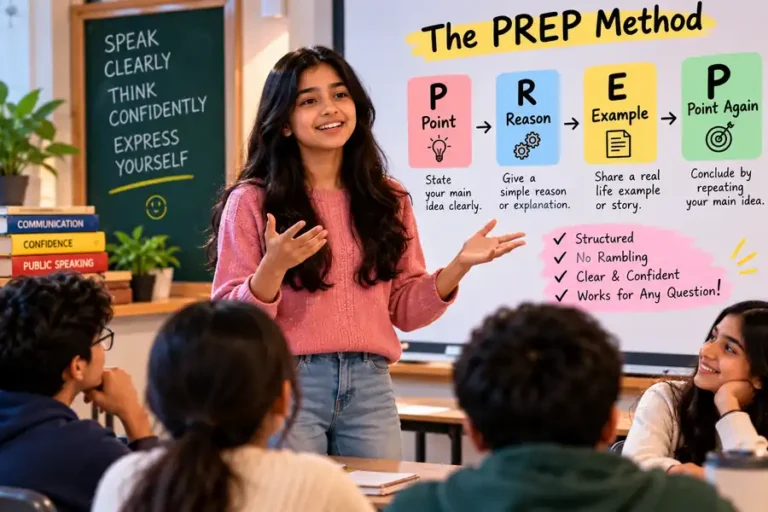
A simple opening line removes the hardest part. Teach phrases like “I think the answer is… because…” or “One thing I noticed was…”. Once the first sentence is out, the rest usually follows.
Praise the attempt, not just the answer
“I liked how clearly you explained that” or “That was brave of you to share” tells a child that speaking up itself is valued, whether or not the answer was perfect.
Practise thinking time
Some children go quiet because they feel rushed. Teach them it’s fine to say, “Let me think for a second.” Pausing isn’t failing. Confident speakers pause all the time.
Start small and build up
Ordering their own food at a restaurant, asking a shopkeeper a question, answering the phone politely, saying a few words at a family function. Each small success makes the next one easier.
What doesn’t help
- Labelling them. “She’s the shy one” can become a story a child starts to believe about themselves.
- Forcing big performances too early. Pushing a nervous child onto a stage without preparation can make the fear stronger.
- Comparing with siblings or classmates. It adds pressure and rarely builds confidence.
When to look for extra support
If anxiety about speaking is causing real distress, like avoiding school, physical symptoms before class, or withdrawing from friends, it’s worth talking to their teacher, the school counsellor or a professional. Those situations deserve more than tips.
For most children, though, what they need is simply more chances to speak in a supportive setting, with simple tools to get started. That’s the idea behind our Speak Up course: like every Z-Alpha-Ed class, it ends with students doing something, not just listening.
Because the answer was always in there. It just needs a way out.
Every Z-Alpha-Ed class ends with students doing something, not just listening.
Found this useful? 💬 Share on WhatsApp ← All articles