Your First ₹1,000: A Simple Budget Plan for Teenagers
You just got ₹1,000. Before it quietly disappears into snacks and recharges, here's a simple three-pocket plan that actually works for teenagers.
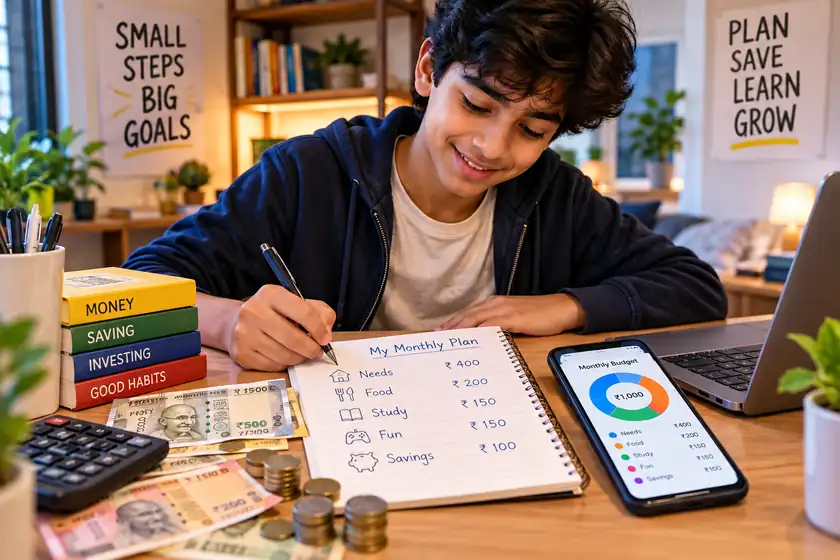
Picture this. It’s the first day of the month, and you’ve just been handed ₹1,000. Maybe it’s pocket money, maybe it’s a birthday gift from your nani, maybe you earned it helping out at a family shop. For about five minutes, you feel rich.
Then the month happens. A couple of canteen samosas here, a mobile recharge there, one “small” online order that wasn’t really small. By the 20th, you’re checking your wallet and wondering where it all went.
If that sounds familiar, you’re not bad with money. You just don’t have a plan yet. And the good news is that a plan doesn’t need spreadsheets or a finance degree. It needs three pockets.
The three-pocket idea
Every rupee you get can go into one of three pockets:
- Needs: things you genuinely have to pay for. A bus pass, stationery for a project, your share of a school trip.
- Wants: things that make life more fun but that you could live without. Movies, snacks, a new phone cover, game credits.
- Savings: money you deliberately don’t touch, for a bigger goal or for a surprise expense later.
Adults often use a rule called 50/30/20: 50% of income for needs, 30% for wants and 20% for savings. For most teenagers, parents already cover the big needs like food and school fees, so you can adjust the split. The important part is not the exact numbers. It’s deciding before you spend.
A real example: Aarav’s ₹1,000
Aarav is in Class 9. He gets ₹1,000 a month. Here’s what his first honest budget looked like:
| What it covers | Amount | |
|---|---|---|
| Needs | Mobile recharge, printouts for school | ₹350 |
| Wants | Canteen treats, one outing with friends | ₹400 |
| Savings | Goal: a ₹2,500 cricket bat | ₹250 |
Notice two things. First, savings come out on day one, not “whatever is left at the end”. If you wait until the end of the month, there is usually nothing left. Second, his savings have a name: a cricket bat. A goal you can picture is far easier to stick to than “saving for the future”.
At ₹250 a month, Aarav reaches his ₹2,500 bat in ten months. If he gets some birthday money in between, even sooner.
How to build your own budget in 15 minutes
- Write down your income. Pocket money, gifts, anything you earn. Use a monthly figure.
- List last month’s spending from memory. Check your UPI history if you have one. Most people are surprised by how much went on small things.
- Sort each item into needs or wants. Be honest. “I needed that bubble tea” doesn’t count.
- Pick one savings goal and a deadline. Something specific: “₹1,500 for headphones by March”.
- Set your three amounts and move the savings amount out first, into a piggy bank, a separate envelope, or a savings account if you have one.
- Check in every week. Two minutes on a Sunday is enough to see if your wants pocket is running out too fast.
The sneaky budget killers
Most budgets don’t fail because of one big purchase. They fail because of tiny ones that don’t feel like spending.
- The ₹20 trap. Twenty rupees a day on small snacks is ₹600 a month. That’s more than half of Aarav’s budget.
- “Only 2 hours left!” sales. Countdown timers are designed to stop you thinking. If you didn’t plan to buy it this morning, wait a day.
- Digital money feels less real. Paying by UPI doesn’t feel like handing over notes, so it’s easier to overspend. Keep an eye on your transaction history.
What if you overspend?
You will, at some point. Everyone does. A budget isn’t a test you pass or fail. It’s a map. If your wants pocket runs dry on the 18th, that’s useful information. Next month you might lower the wants amount, or find a cheaper way to do the same thing, like having friends over instead of going out.
The one rule worth keeping: don’t borrow from your savings pocket for wants. The moment savings becomes “spare cash”, your goal quietly disappears.
Why this matters more than it seems
Managing ₹1,000 a month might sound small. But the habit you build now, deciding where money goes before it’s spent, is exactly the same habit you’ll need when the amount is ₹50,000 and the needs include rent and EMIs. Learning it with pocket money is the cheapest way to learn it.
So this month, try the three pockets. Write it down, name your goal, and move your savings first. Then see how different the 20th feels.
Every Z-Alpha-Ed class ends with students doing something, not just listening.
Found this useful? 💬 Share on WhatsApp ← All articles