How to Talk to Your Child About Money (Without Giving a Lecture)
Most of us learned about money by watching, not by being taught. Here's how parents can turn everyday moments into money lessons children actually remember.
Ask most adults where they learned about money, and you’ll hear some version of the same answer: “Nobody really taught me. I figured it out.” Usually that means figuring it out through a few expensive mistakes.
Many parents want something better for their children, but aren’t sure where to start. Money can feel like a private, slightly awkward topic. And nobody wants to sit their teenager down for a lecture they’ll tune out of in thirty seconds.
The good news is that the best money lessons don’t look like lessons at all. They happen in small, everyday moments.
Start with a simple truth: children are already watching
Children notice how money is handled at home long before anyone explains it. They see whether purchases are planned or impulsive, whether bills cause stress, and whether people talk openly or go quiet when money comes up.
That’s not a reason to worry. It’s an opportunity. Explaining out loud what you’re already doing is one of the easiest ways to teach.
“We’re not buying this today because it’s not in this month’s plan. Let’s add it to next month’s list.”
One sentence like that teaches planning, patience and the idea that money is finite, without a lecture in sight.
1. Make pocket money a learning tool, not just a habit
Pocket money works best when it comes with a little responsibility attached. A few ideas:
- Give it on a fixed day. Predictability lets children plan.
- Hand over a real responsibility. For example, their mobile recharge or school snacks now come out of their pocket money.
- Don’t rescue every shortfall. If they spend it all in the first week, a few days of going without teaches more than any talk could. Be kind, but let the lesson land.
2. Turn “Can I have this?” into a thinking question
When a child asks for something, try responding with a question instead of an instant yes or no:
- “Is this a need or a want?”
- “What would you give up to get it?”
- “Will you still want it in two weeks?”
The goal isn’t to say no more often. It’s to help them build the habit of pausing before spending, which is the single most useful money skill there is.
3. Use shopping trips as quiet maths lessons
The supermarket is full of real-life problems. Hand your child the list and a budget. Ask them to compare two pack sizes and work out which is better value. Let them check the bill. Children who learn to compare prices at 12 rarely fall for “fake discounts” at 25.
4. Help them save for something specific
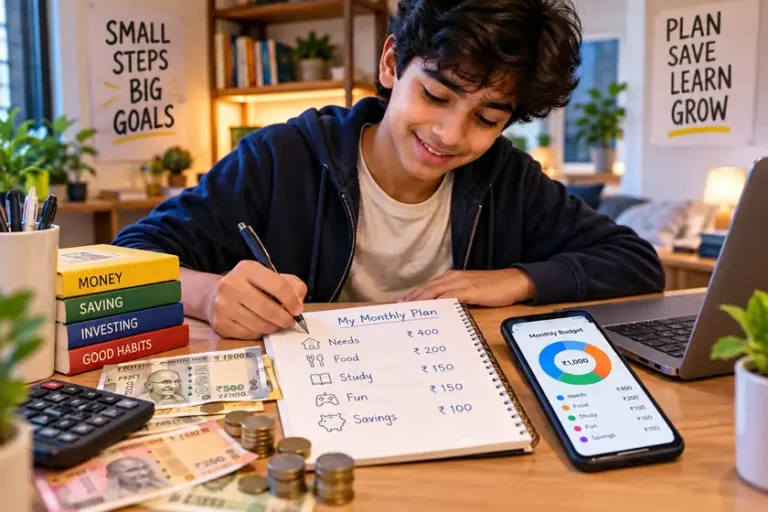
“Save your money” is vague. “Save ₹1,500 for that football by March” is a goal. Write it down, maybe draw a simple chart on the fridge, and let them colour in progress. Some families offer a small top-up, for example ₹1 added for every ₹10 saved, to show how savings can grow.
When they finally buy the thing they saved for, talk about how it felt. That feeling is worth more than the football.
5. Talk about digital money early
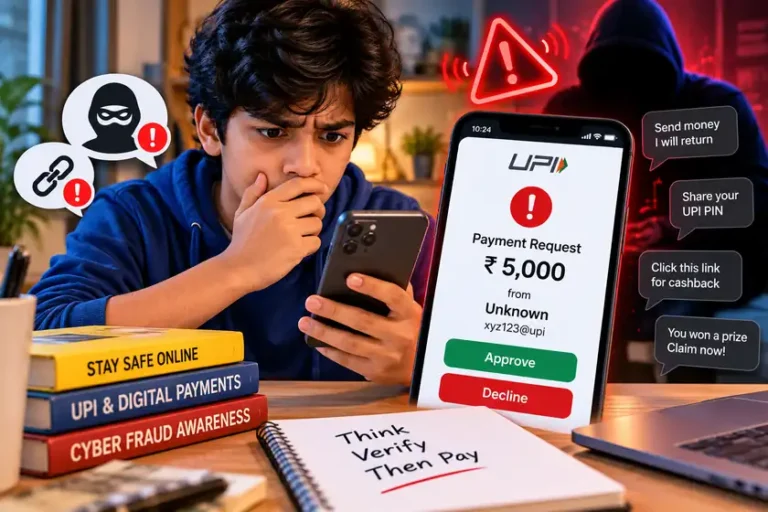
Today’s children may make their first payment with a phone, not a wallet. Digital money feels less real, which makes overspending easier. It also comes with risks like scam messages and fake payment requests.
Sit with your child and look at a UPI transaction history together. Explain that a PIN is like a house key and never to be shared. Make it clear they can always come to you if something looks suspicious, without being scolded.
6. Let them see mistakes, including yours
“I bought this jacket on a sale and never wore it. I got carried away.” Admitting small mistakes shows children that money decisions are something everyone gets better at, not something you’re either good or bad at. It also makes them more likely to tell you when they make a mistake of their own.
What to avoid
- Money as a source of fear. Children don’t need to carry adult worries. Keep the tone calm and practical.
- Endless lectures. Short, real moments beat long talks every time.
- “We can’t afford it” as the only answer. Sometimes “We’re choosing to spend on something else” teaches more about priorities.
The long game
You don’t need to cover everything this week. Money confidence is built slowly, through hundreds of small conversations. If your child grows up knowing how to make a plan, wait before buying, save toward a goal and spot a scam, you will have given them something many adults never got.
And if you’d like support, structured practice helps too. In our Financial Literacy course, students learn these ideas through challenges, simulations and games, so the lessons stick.
Every Z-Alpha-Ed class ends with students doing something, not just listening.
Found this useful? 💬 Share on WhatsApp ← All articles