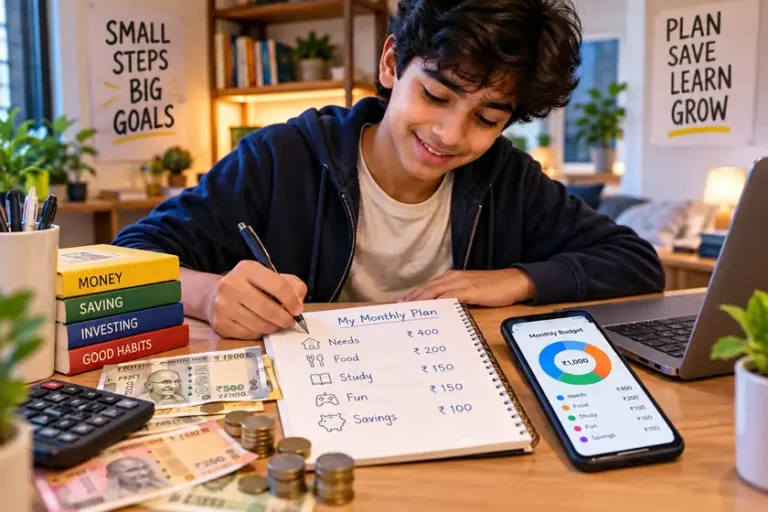
UPI Scams Targeting Students: 7 Red Flags to Spot Before You Pay
Scammers love new UPI users because they're still learning how things work. Here are the seven tricks that come up again and again, and how to spot each one.
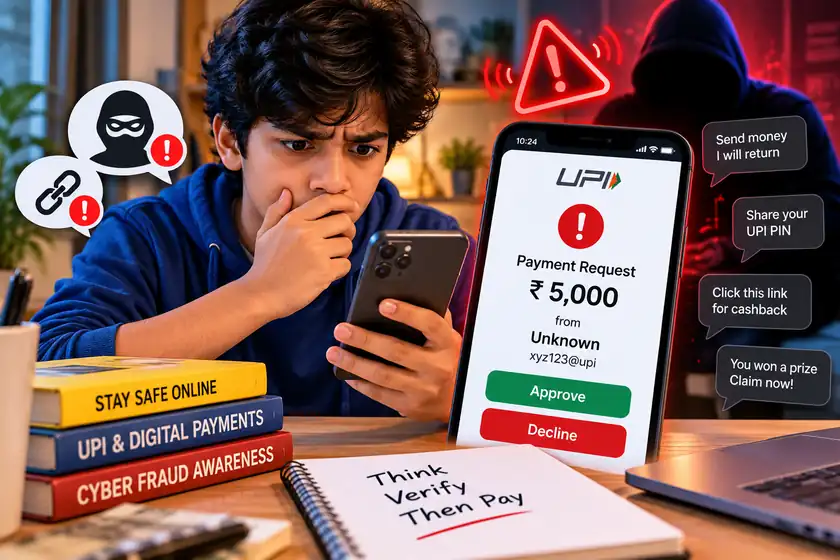
UPI has made paying for things ridiculously easy. Scan, tap, enter PIN, done. But anything that makes payments easy also makes mistakes easy, and scammers know it.
Students are a favourite target. You might be new to managing your own money, you might be on your phone a lot, and you might not want to admit to your parents that you clicked something you shouldn’t have. Scammers count on all three.
The good news: almost every UPI scam uses one of a handful of tricks. Learn to spot them, and you’ll be safer than many adults.
First, the one rule that stops most scams
You never need to enter your UPI PIN to receive money. Never. Your PIN is only for sending money out of your account. If anyone, or any screen, asks you to enter your PIN to “receive” a payment, a refund or a prize, it’s a scam. Full stop.
Remember that one line and you’ve already blocked a huge share of tricks.
Red flag 1: The “collect request” disguised as a payment
You’re selling an old book online. A “buyer” says they’ll pay you and sends a request on UPI. The screen shows ₹500 and a button saying Pay. If you tap it and enter your PIN, the ₹500 leaves your account.
Spot it: a real payment to you just arrives. You don’t have to approve anything.
Red flag 2: The QR code you’re asked to scan to “get paid”
Similar trick, different tool. Someone sends a QR code and says, “Scan this to receive the money.” Scanning a QR code and entering your PIN is how you pay, not how you receive.
Spot it: if you’re the one receiving money, you should be showing your QR code, not scanning theirs.
Red flag 3: “Your KYC expires today”
A message claims to be from your bank: your account will be blocked unless you update your KYC through a link, or share the OTP you’re about to receive.
Spot it: banks don’t ask for OTPs, PINs or passwords by message or phone call. Urgency (“today”, “within 2 hours”, “account will be blocked”) is a pressure tactic. Close the message and check directly in your bank’s official app.
Red flag 4: The “oops, I sent money to you by mistake” call
You get a message saying ₹2,000 was credited to you by mistake, followed by a call asking you to send it back. Sometimes the “credit” message is fake and no money arrived at all. Sometimes a request is sent that looks like a refund.
Spot it: check your actual balance in your bank app, not the SMS. If money really did arrive by mistake, the sender’s bank can reverse it through official channels. You don’t need to do anything in a hurry.
Red flag 5: Prizes, lucky draws and “free” gifts
“Congratulations! You’ve won ₹25 lakh. Pay a ₹5,000 processing fee to claim your prize.” Or a link promising free game credits, a free phone or cashback.
Spot it: you can’t win a draw you never entered, and real prizes never ask you to pay to receive them.
Red flag 6: Screen-sharing apps
Someone claiming to be “customer support” asks you to install an app so they can “help fix the problem”. Some of these apps let them see your screen, including your OTPs and the PIN you type.
Spot it: never install an app because a caller told you to. Real support teams don’t need to see your screen to fix a payment problem.
Red flag 7: The friend with a “new number”
“Hi, it’s me, new number! I’m stuck, can you send ₹3,000 urgently? Will explain later.” It might use the name and photo of a real friend or relative.
Spot it: call the person on their old, known number before sending a single rupee. A real friend won’t mind you checking.
What all seven have in common
Look closely and every scam above uses at least one of these:
- Urgency: act now, no time to think.
- Emotion: excitement about a prize, fear of a blocked account, guilt about someone’s “mistake”.
- A request to enter your PIN, share an OTP, or click a link.
When you notice those three things together, slow down. A real bank, a real friend or a real buyer will still be there in ten minutes.
If something has already gone wrong
It happens, even to careful people. Don’t hide it. Tell a parent or trusted adult straight away, because speed matters. Contact your bank through the official app or the number on the back of your card. In India, you can also report cyber fraud on the national helpline 1930 or at cybercrime.gov.in.
Feeling embarrassed is normal. But scammers are professionals, and the faster a fraud is reported, the better the chance of stopping it.
A quick challenge
Before you finish reading, open your UPI app and look at your settings. Do you know how to check your transaction history? Do you know how to block a contact? Spending two minutes on this now is much easier than learning it during a panic.
Want to test yourself? Try our free Spot the Scam game and see how many fake messages you can catch.
Every Z-Alpha-Ed class ends with students doing something, not just listening.
Found this useful? 💬 Share on WhatsApp ← All articles